Imagine having to make two months of your income last for a whole year . . .
That was Sali’s life—and it wasn’t easy.
Poverty Hurts Families
I remember hearing my grandmother’s stories of raising 11 children in rural Ireland in the 1950s on one meagre income.
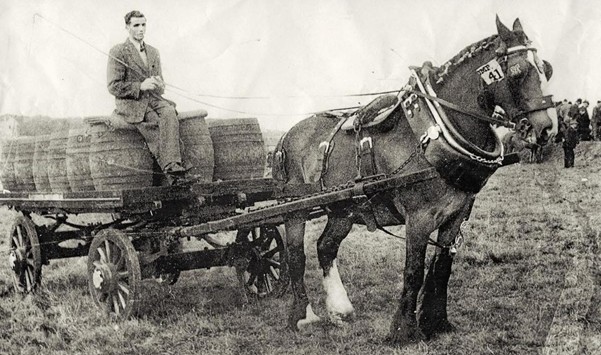
My grandfather was a delivery driver, using a horse-drawn cart to supply businesses in Ballina, Co. Mayo. They didn’t have much money to buy food, so Granny would forage for rabbits and mushrooms to keep them all going.
Their neighbours lived similarly difficult lives, but she told me many stories of ways they helped each other whenever they could.
I’m proud to hail from such resourceful and generous people.
It’s hard to believe that around 70 years later, some parents are still having to forage to feed their families.
It doesn’t seem right when we can help.
Times Have Changed…But Not For Everyone
Sali lives in Cambodia, a tropical country with just two seasons: rainy and dry. She relies on her small farm to feed herself, her husband, seven-year-old son, Sok, and three extended family members.
And her farm relies on rain that only falls during two months of the year.
As the climate in Cambodia becomes warmer, the dry season is becoming longer and hotter and the wet season shorter and more destructive.
As a result, the land is much harder to farm, and Sali was only able to grow produce for two months of the year.
Like my grandmother, to supplement her income, she foraged—collecting wild vegetables and catching the few fish still swimming in the depleted river.
It was barely enough, and it left Sali and her family living day-to-day without the means to create a better future for themselves or the next generation.
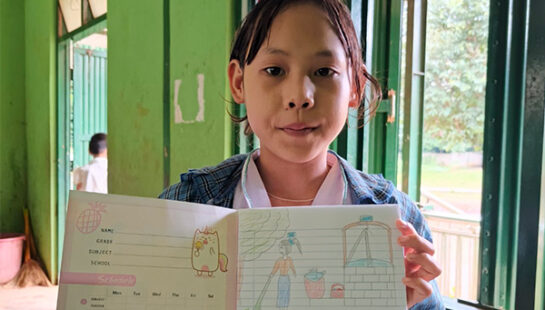
School supplies cost money that Sali didn’t have, so Sok missed out on an education, making it likely that he would face a life of poverty just as his parents and grandparents had.
The Harsh Reality For Farmers
According to World Food Bank, as it stands, the temperature in Cambodia is on track to continue rising, and this will result in ‘increasing pressures on human health, livelihoods, and ecosystems.’
This is a problem that’s not going away any time soon.
There’s an inherent injustice in the fact that the world’s most vulnerable, like Sali, feel the most profound effects of a changing climate—especially when these countries are the least responsible, and are diligently working towards sustainable practices.
Cambodia, for example, contributes less than one per cent of the world’s greenhouse gasses, but has signed on to the Paris Agreement and has 163 measures in place to reduce carbon emissions, as published in its 2025 National Council for Sustainable Development report.
It is heartening to see this commitment, and Cambodia as a country has made enormous gains in recent years.
But around 80 per cent of the population live in rural communities where subsistence farming remains the main source of livelihood for families.
Many, like Sali, her parents and grandparents, missed out on education, and use rudimentary farming methods that can’t fight the effects of the hotter, dryer conditions. It means intergenerational poverty is common in many communities.
Working Directly With Communities Like Sali’s
Our Christian Partners work directly with Cambodians to equip them with the skills and technology they need to turn their farms around, and change this cycle of intergenerational poverty.
Working with members of several households at a time, our Partners help people by:
- Teaching them how to buy better seeds and make sustainable fertiliser for more resilient and profitable crops
- Showing them how to raise healthy chickens and run a small business to sell their produce
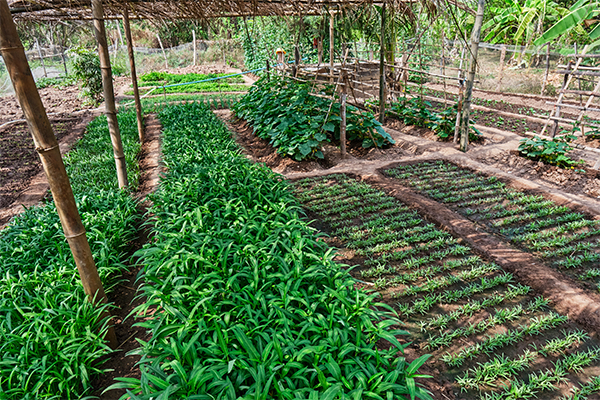
- Helping them set up solar run pumps so that water can feed their crops all year around—not just for two months of the year
A Dramatically Different Story
With this new training, Sali has dramatically changed the story for her family.
She now grows plenty of vegetables and raises flocks of chickens—enough to feed her family as well as sell at the market.
Because of this, she has money to send Sok to school and to invest in a larger, more secure house.
And she’s also sharing her knowledge with her neighbours, even though it means she’ll have fewer customers, because she knows it’s better to work together.
‘I’m happy that my family is able to generate income from my vegetable garden and chicken raising. It has made the living circumstances of my family considerably better than before,’ she said.
‘I would like to see my child to accomplish a higher education and have a bright future.’
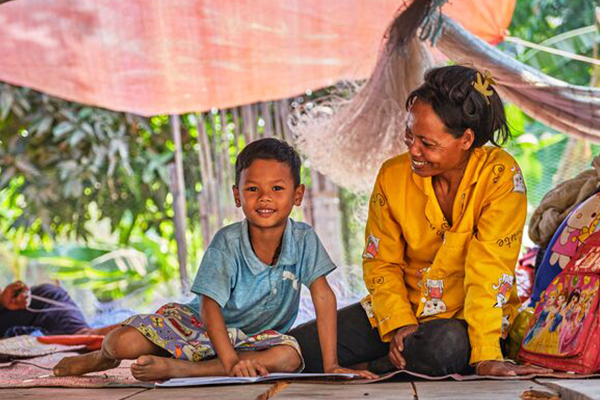
A difficult climate will continue to challenge Cambodia’s rural communities for some time. But they’re not dwelling on the unfairness of this because they’re busy with solutions. With support from our local Christian Partner, families like Sali’s are finding ways to thrive now, and create a future for their children that doesn’t include poverty.

 Sophia Russell,