
Do you feel like our summers are getting stickier? You’re not imagining it. According to scientists at the University of NSW, dew point levels are rising alongside the temperature of the oceans, making our summers hotter and more humid.
It’s not just us—a change in the climate is impacting every country around the world. And while Australia has had some scary bushfires and floods, these are thankfully rare. For people in lower socio-economic countries, the effects of a changing climate have a daily negative impact on family life.
In Uganda
Axel (pictured above) is 10 years old and lives in Uganda with his mum, dad and four siblings. It’s a country that has faced significant environmental challenges over recent decades, making life even more difficult for already vulnerable communities.
Uganda has a tropical climate that has been dramatically impacted by increased temperatures. According to the World Bank, Uganda’s climate risk shows a steady increase in temperature over the past 20 years, leading to some regions experiencing more frequent, longer-lasting drought conditions. When it does rain, floods and landslides threaten life and livelihoods as homes, soil and crops are washed away. And in a country where around 80 per cent of the population rely on subsistence farming, that’s over 40 million people fighting to stay safe and feed their families.
The local communities where our Christian Partners work are extraordinary at implementing long-term, smart solutions that meet these challenges and care for creation. Axel’s family, for example, is part of our local Partner’s tree planting initiative. By planting thousands of seedlings, this community will see steadier rainfall in the future through evapotranspiration—a process where trees draw water up from the soil, adding more water vapour to the atmosphere and boosting humidity, which leads to greater cloud formation and better rainfall. Tree roots also reduce soil erosion, and their leaves provide much-needed shade while consuming carbon dioxide. ‘I will be happy when the trees that I have planted grow and provide us good shade,’ said Axel.
I will be happy when the trees that I have planted grow and provide us good shade.—Axel
In Kenya
Kenya is also grappling with the impact of a changing climate. According to the World Bank, droughts have become more frequent and prolonged in parts of the country, occurring every two to three years instead of every five to ten. This has made it difficult for rural families, who rely on consistent rainfall and fertile grasslands, to earn a living.
In one region where our Partners serve, the land has been barren for decades, and many people in the community had given up on regenerating it—but not the Women’s Self Help Group.
In October 2025, after receiving training from our Partner, the group’s members dug soil bunds along the slopes of the land (pictured below). These are raised embankments that intercept and slow down water run-off, giving the soil time to absorb the water. When rainfall is erratic, soil bunding improves soil moisture levels and help prevent erosion.

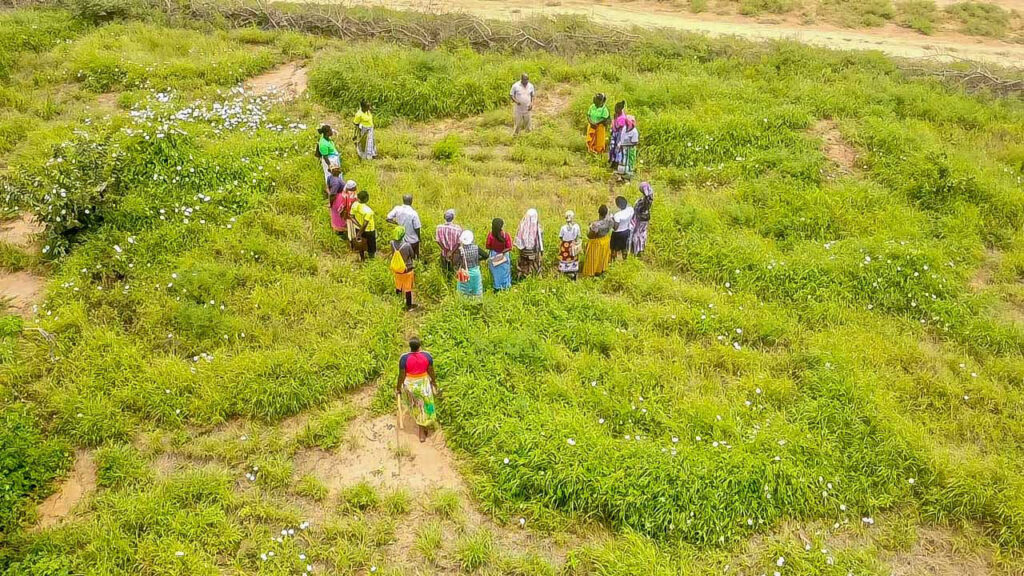
Despite the scepticism of their neighbours, the women’s determined efforts paid off, transforming once-barren earth into lush, fertile soil. When the grass is ready for harvest, they’ll be able to use it as livestock fodder, and sell both the grass and seeds to create two sources of income. ‘Next dry season, these women will teach others to do the same,’ said International Programs Coordinator, Ada Lee. ‘Soil bunding is an effective, low cost, technique that not only conserves the environment, but also creates new, diversified income sources for vulnerable women.’
The women’s determined efforts paid off, transforming once-barren earth into lush, fertile soil.
The changing climate has serious implications for vulnerable communities. But when supported, communities show tremendous resilience in caring for creation, implementing ingenious solutions that change the trajectory from dire to a secure and sustainable future.
This article first appeared in the Better World Magazine—Edition 11.
 Melissa Lipsett,

 Laura,
